
What if sin does not just affect the soul?
What if it affects the body too?
Before you dismiss that question as merely religious, consider something. Long before modern medicine understood inflammation, chronic stress, addiction pathways, hormonal dysfunction, or the toll of emotional distress on the body, ancient spiritual traditions warned humanity about specific patterns of behavior that slowly destroy human flourishing.
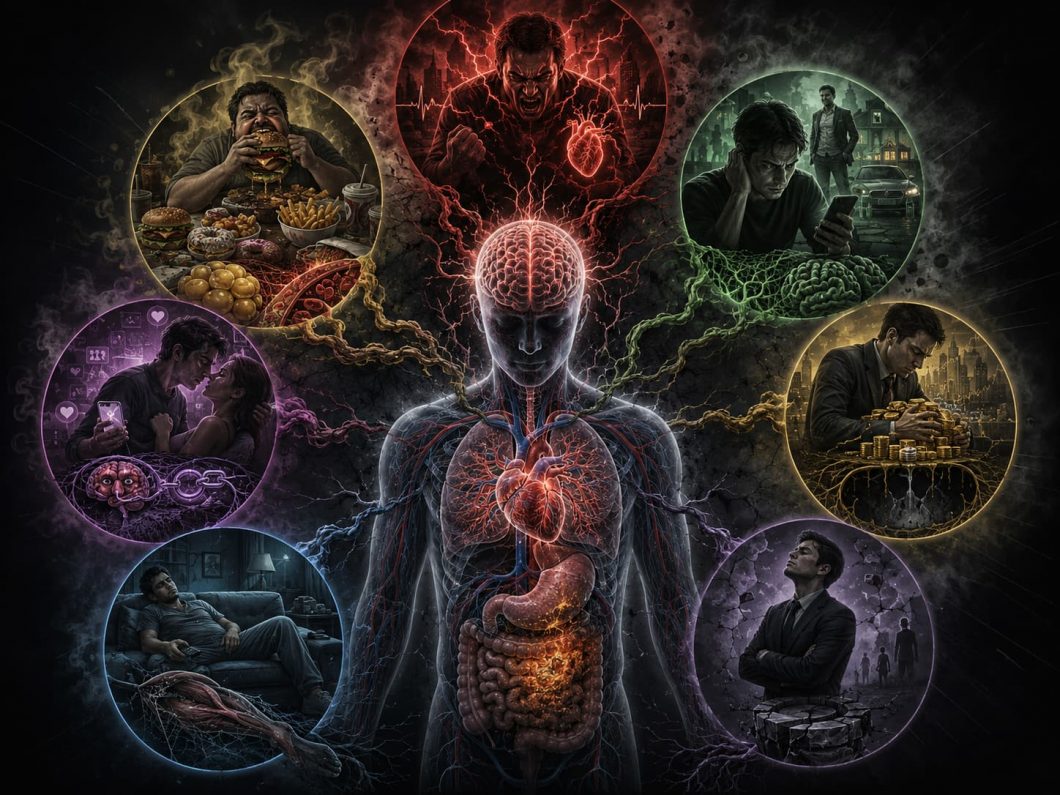
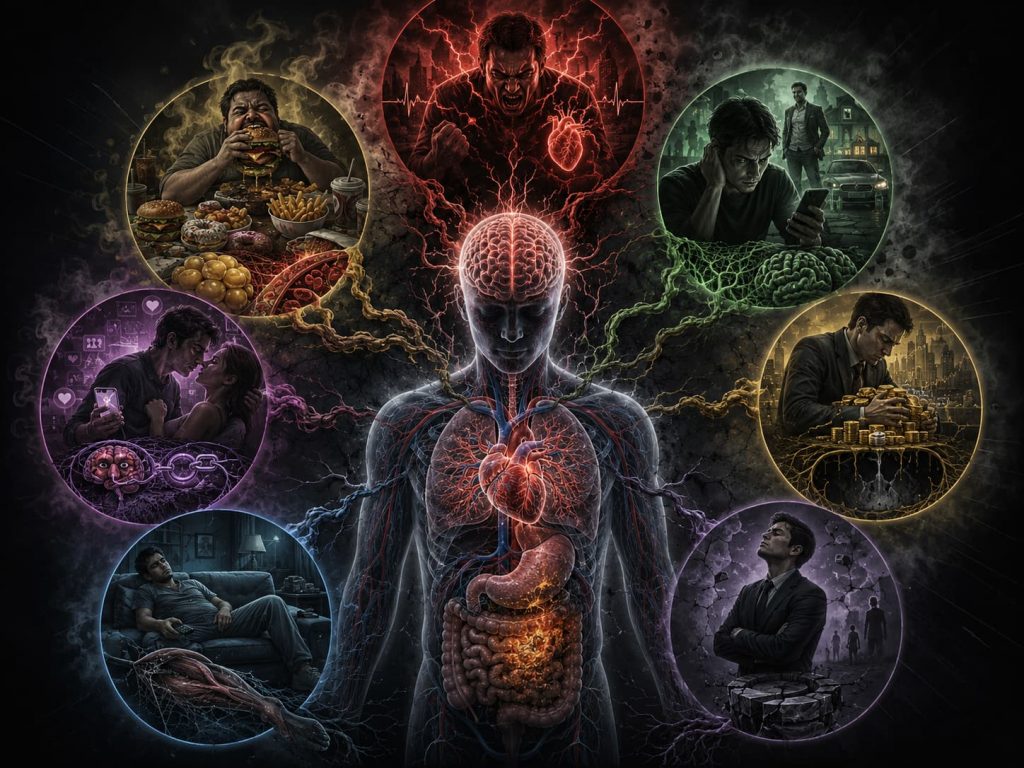
Among those warnings were what became known as the seven deadly sins: gluttony, wrath, envy, greed, lust, pride, and sloth.
Traditionally these have been viewed through a spiritual lens. Habits that separate us from God and distort our character. But when you examine the seven deadly sins through the lens of modern psychology and health science, something remarkable emerges.
Many of these behaviors create the exact conditions associated with physical decline, emotional suffering, and chronic disease.
Perhaps the ancient warning was not only spiritual.
Perhaps it was biological too.
Sin Was Never Just a Spiritual Problem
One of the greatest mistakes people make is viewing sin only as a moral issue.
In Scripture, sin is often portrayed as something that produces death. While Christians typically understand this as spiritual death, the reality is that sin frequently produces forms of death long before a person ever reaches the grave.
Relationships die.
Trust dies.
Peace dies.
Purpose dies.
And often, health begins to decline as well.
The Bible consistently presents God’s commands not merely as rules but as pathways toward life. When those pathways are abandoned, consequences follow. This is the same root issue at work in the difference between shame and guilt, where the weight we carry shapes far more than our conscience.
Modern science increasingly confirms what ancient wisdom suggested for thousands of years. Destructive behaviors create destructive outcomes.
The Connection Between Sin and Human Health
Researchers continue to find strong links between chronic stress, inflammation, emotional dysregulation, addiction, social isolation, and disease. A landmark study in the Proceedings of the National Academy of Sciences found that prolonged stress disrupts the body’s ability to regulate inflammation, which plays a role in the onset of a wide range of diseases.
Interestingly, every one of the seven deadly sins contributes to one or more of those conditions.
This does not mean every illness is caused by personal sin. Such a conclusion would be both simplistic and unbiblical.
It does suggest that many sinful patterns create environments within the mind and body that undermine health and well-being.
Let’s take a closer look at all seven.
1. Gluttony and the Cost of Excess
Gluttony is often reduced to overeating, but at its core, gluttony is the inability to regulate appetite.
When appetite becomes the master, the body pays a price.
Excessive consumption contributes to obesity, metabolic dysfunction, cardiovascular disease, insulin resistance, and chronic inflammation. The body was designed to receive nourishment, not to be overwhelmed by excess.
The problem is not food itself.
The problem is when desire becomes disordered.
2. Wrath and the Physiology of Anger
Anger is a normal human emotion.
Wrath is sustained anger that begins to dominate a person’s life.
When anger becomes chronic, the body remains trapped in a prolonged stress response. Cortisol rises. Blood pressure increases. Inflammation increases. Sleep quality declines.
Over time, the body bears the burden of unresolved hostility.
The person may believe they are punishing someone else. Often they are slowly punishing themselves.
3. Envy and the Stress of Comparison
We live in a world built on comparison.
Social media allows people to compare their appearance, income, relationships, achievements, and lifestyles to thousands of others every day.
Envy keeps the mind focused on what is missing.
It creates chronic dissatisfaction.
Rather than experiencing gratitude for what is present, the individual becomes consumed by what someone else possesses.
The nervous system learns to operate from scarcity rather than abundance.
Peace becomes difficult to sustain because enough never feels like enough.

4. Greed and the Never-Enough Trap
Greed often disguises itself as ambition.
Healthy ambition seeks growth.
Greed seeks satisfaction through accumulation.
The problem is that human beings quickly adapt to achievement. What once felt extraordinary soon becomes normal. The next goal appears. Then the next. Then the next.
The pursuit never ends.
Psychologists call this hedonic adaptation.
Scripture calls it chasing after the wind.
The result is often chronic striving without lasting contentment.
5. Lust and the Dysregulation of Desire
Lust is not simply sexual attraction.
It is desire detached from wisdom, restraint, and healthy boundaries.
When pleasure becomes compulsive, the brain’s reward systems begin to adapt. The individual often requires greater stimulation to achieve the same level of satisfaction.
Over time, craving grows while fulfillment decreases.
The person is left pursuing more while experiencing less.
This pattern extends far beyond sexuality. It can affect entertainment, substances, attention, validation, and countless other forms of pleasure-seeking behavior.
6. Pride and the Refusal to Grow
Pride is one of the most deceptive sins because it often appears as strength.
Yet pride frequently prevents learning.
It rejects correction.
It resists feedback.
It refuses accountability.
In both biology and psychology, adaptation is essential for growth and survival. Individuals who stop learning eventually stagnate.
Pride convinces a person they have already arrived.
Humility allows them to keep growing. This is why a secure identity in Christ matters so much. When your worth is settled, you no longer need pride to defend it, and you can finally receive the correction that helps you grow.
7. Sloth and the Slow Decline of Inactivity
Sloth is often misunderstood as laziness.
In reality, it is resistance to the effort required for growth.
Human beings were designed for movement.
Physically, inactivity contributes to weakness, disease, and decline.
Mentally, inactivity can foster depression, hopelessness, and reduced resilience.
Spiritually, inactivity often leads to stagnation.
Growth requires engagement.
The absence of challenge eventually produces deterioration.
What Modern Science and Ancient Wisdom Agree On
When you step back and examine the seven deadly sins collectively, a pattern emerges.
Each one contributes to some combination of chronic stress, inflammation, addiction, isolation, emotional dysregulation, hormonal imbalance, and psychological distress.
These are many of the same factors modern science associates with aging and disease.
Again, this does not mean that all suffering is the direct result of personal sin.
It does mean that many destructive patterns produce predictable consequences.
The body keeps score.
Sin, Stress, and the Human Condition
Perhaps one reason God warns us about sin is because He understands human design better than we do.
The Creator knows what creates life and what creates destruction.
Sin is not merely breaking rules.
It is operating against the design specifications of human flourishing.
The further we drift from healthy design, the greater the consequences become.
Sometimes those consequences are spiritual.
Sometimes they are emotional.
Sometimes they are physical.
Often they are all three.
The Hope Beyond the Pattern
The good news is that Christianity does not stop with identifying the problem.
It offers transformation.
The goal is not behavior modification alone.
The goal is restoration.
Where gluttony seeks excess, God teaches self-control.
Where wrath fuels destruction, God teaches forgiveness.
Where envy creates scarcity, God teaches gratitude.
Where greed pursues more, God teaches contentment.
Where lust consumes, God teaches discipline.
Where pride resists growth, God teaches humility.
Where sloth avoids effort, God calls us into purposeful living.
The seven deadly sins are not merely behaviors that damage the soul.
They are patterns that damage the whole person.
And if that is true, then repentance is not simply a spiritual act.
It may be one of the healthiest things a human being can do.
Frequently Asked Questions
What are the seven deadly sins?
The seven deadly sins are gluttony, wrath, envy, greed, lust, pride, and sloth. They are a traditional grouping of human tendencies that the Christian tradition has long taught lead a person away from God and toward destruction. Each one describes a disordered pattern rather than a single act.
Can the seven deadly sins really affect your physical health?
Yes, often indirectly. Many of the patterns behind the seven deadly sins produce chronic stress, inflammation, addiction cycles, and isolation, which research links to a wide range of physical and mental health problems. This does not mean every illness is caused by sin, but it does mean destructive patterns tend to carry destructive consequences for the body.
Are the seven deadly sins in the Bible?
The exact list of seven is not found as a single passage in Scripture. It was developed in early church tradition as a way to categorize root patterns of sin. The individual behaviors, however, are addressed throughout the Bible, which consistently frames God’s commands as pathways toward life rather than arbitrary rules.
What is the opposite of the seven deadly sins?
The traditional counters are the seven heavenly virtues: temperance, patience, kindness, charity, chastity, humility, and diligence. In practical terms, the antidote to each destructive pattern is its life-giving opposite, such as gratitude in place of envy or contentment in place of greed.
How do I begin to break free from these patterns?
Start by naming the specific pattern honestly rather than excusing it. Real change usually involves a combination of self-awareness, accountability with trusted people, and a deepening trust in God who offers restoration rather than mere behavior modification. Repentance is not a one-time event but a daily turning toward life.
Repentance Is Not Just Spiritual. It Is Healing.
The seven deadly sins were never just a list of bad behaviors. They are patterns. And patterns shape the whole person, body, mind, and soul.
If you recognize yourself in any of these, that recognition is not condemnation. It is the first step toward freedom.
This is exactly the work You Are the Pattern by Tony Taylor was written for. It does not hand you cliches or shame. It holds up a mirror to the cycles that quietly run your life, and then it shows you the way out.
Because the pattern does not change until you stop pretending it is not there.
Get your copy at tonytaylorbooks.com.