
You already know the right response. You have thought about it a hundred times. And then the moment comes and you do the other thing.
The sharp tone. The silence. The sarcasm you did not mean. The shutdown that lasts for hours. The apology that comes too late, after the damage is done.
This is not a willpower problem. It is not a character flaw. It is a nervous system that learned to move faster than your values. And until you understand why that happens, knowing what you should do will not change what you actually do.
Here is how to stop being reactive in a way that sticks.

What Reactive Behavior Actually Is
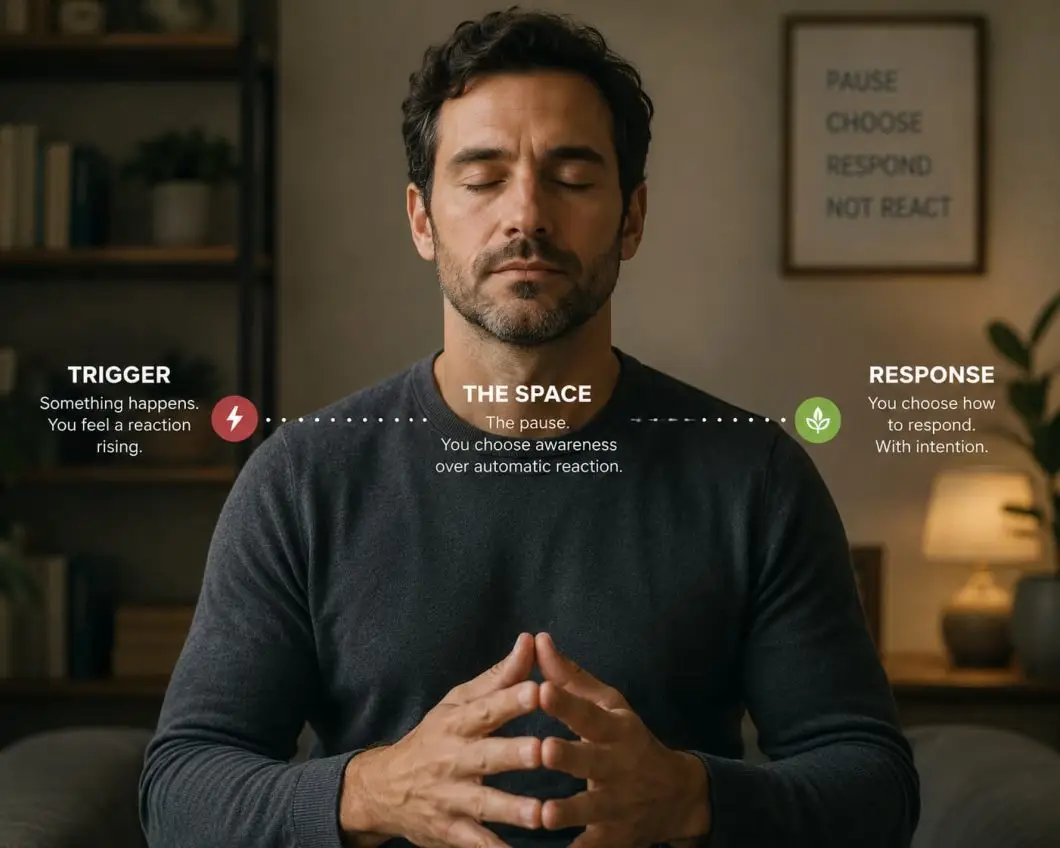
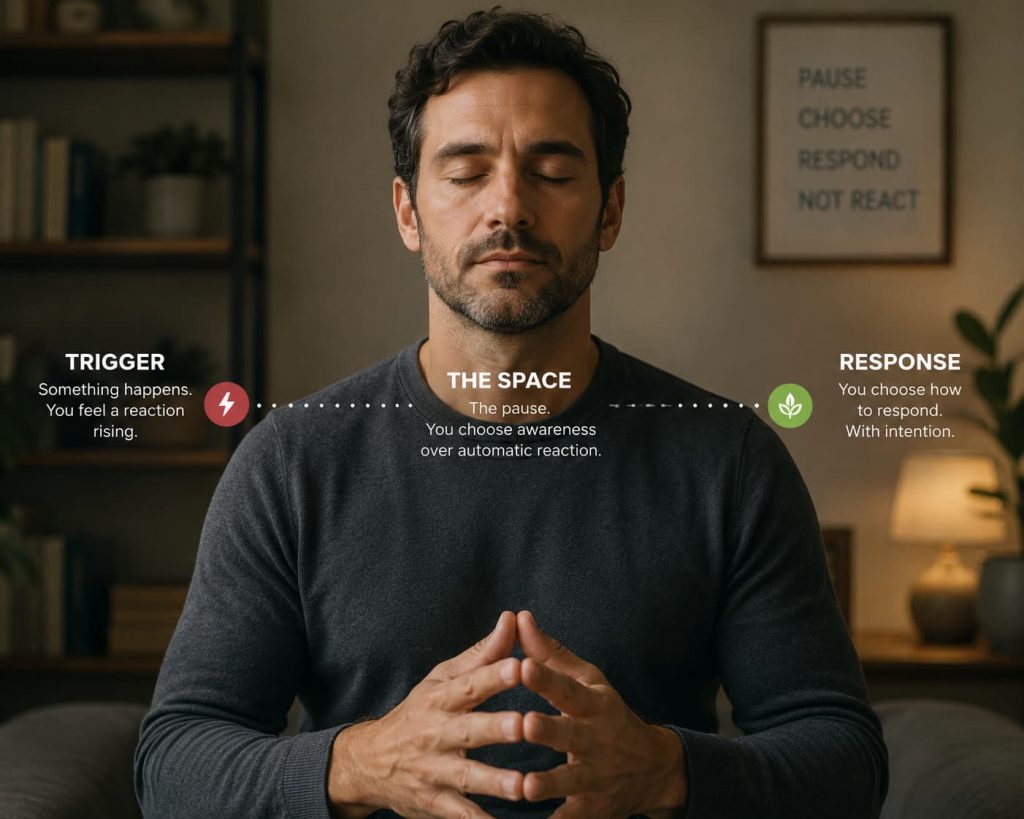
Reactivity is not the same as having strong emotions. You can feel intensely and still respond thoughtfully. Reactivity is what happens when the emotion moves straight into action without passing through any kind of internal filter. The trigger arrives. The response fires. The gap between them is almost zero.
That gap is everything. It is where choice lives. And most people are operating with almost none of it.
Reactive behavior is often rooted in one of three things: unprocessed pain that makes certain situations feel more dangerous than they are, attachment patterns formed in childhood that trained your nervous system to respond in specific ways, and a body that never learned to recognize the difference between a present-day conflict and a past-day threat. Until you address what is driving the reactivity, you are just trying to hold the lid on a pot that is still boiling.
Why You Keep Reacting Even When You Know Better
The prefrontal cortex is the part of your brain responsible for judgment, empathy, long-term thinking, and response selection. It is the part that knows better. The amygdala is the part responsible for threat detection. It is fast, blunt, and operates below conscious awareness. When it detects a signal that resembles past danger, it fires a response before your prefrontal cortex has time to weigh in.
This is why knowing what to do is not enough. By the time your reasoning mind forms a thoughtful response, your reactive mind has already acted. The goal of learning how to stop being reactive is not to silence your emotions. It is to slow the gap between signal and response long enough for your values to show up.
7 Proven Steps to Stop Being Reactive
1. Learn to Recognize Your Early Warning Signs
Reactivity does not appear from nowhere. It builds. Before you raise your voice, your jaw tightens. Before you shut down, your chest constricts. Before you say the thing you will regret, something shifts in your body that you have likely learned to ignore. Your first task is to get curious about that shift. The earlier you recognize the signal, the more time you have to interrupt the pattern.
2. Create a Gap Before You Respond
Creating a gap means inserting space between the trigger and your response. Not suppressing the emotion. Not pretending you are fine. Just choosing not to act on the signal immediately. James 1:19 says to be quick to listen and slow to speak. That is not a personality type. That is a practice. Start with five seconds. Then ten. The goal is to hold enough space for your prefrontal cortex to come back online before your response exits your mouth.
3. Regulate Your Nervous System Before You Engage
If your nervous system is activated, you are not thinking clearly. When your body is in a threat response, blood flow shifts away from the prefrontal cortex. You cannot reason your way out of that state. A four-count inhale followed by a six-count exhale activates the parasympathetic nervous system and signals your body that the threat has passed. This is a direct intervention on the vagus nerve, not a coping trick.
4. Name the Emotion You Are Actually Feeling
Reactive behavior often happens because you are responding to one emotion while experiencing another. You are afraid, but it comes out as anger. You are hurt, but it comes out as withdrawal. You are ashamed, but it comes out as defensiveness. Naming the real emotion reduces its intensity and gives you accurate information about what you actually need.
5. Identify the Story You Are Telling Yourself
Between the trigger and your reaction, your brain constructs a story. She does not care. He is dismissing me. They are doing this on purpose. That story is almost always built from old material. When you feel a reactive response building, pause and ask: what am I telling myself about this situation? Is that story accurate? Is there another explanation I have not considered?
6. Trace the Root, Not Just the Reaction
Every pattern of reactivity has a root. Most chronic reactivity traces back to a wound that never healed, an attachment pattern that formed in early relationships, or a belief about yourself installed before you had the capacity to evaluate it. The shame underneath reactive behavior often runs deeper than people expect. The identity questions underneath the patterns are frequently the actual issue.
7. Build a Response Plan Before You Need It
The worst moment to decide how you want to respond is in the middle of the trigger. Decide in advance: when I feel dismissed in a conversation, I will take a breath and say, “Let me think about that for a moment.” When I feel attacked, I will remove myself briefly and return when regulated. Pre-decisions keep your values in the driver’s seat instead of your wound.
Reactivity Is a Pattern, Not a Personality
You are not a reactive person. You are a person with patterns that were built for a different season of your life. The reactivity that protected you in your family of origin made sense when you needed it. It does not serve you now in the same way. Emotional health work that leads to lasting change starts with understanding the why before you can change the what. Reactivity is not destiny. It is a starting point.
Take the First Step
If you recognize your patterns in what you just read and you are tired of the cycle repeating, start with the Stuck on Repeat workbook. It is a free 10-minute self-audit that helps you name the cycle you keep finding yourself in, identify what belief is driving it, and take the first honest step toward building something different.
Get the Stuck on Repeat Workbook
If you want to go deeper into the patterns underneath your reactivity, You Are the Pattern by Tony Taylor connects the psychological and spiritual roots of the cycles you keep repeating, and what it actually takes to break them.
Get the book at tonytaylorbooks.com
Frequently Asked Questions About Stopping Reactive Behavior
Why do I keep reacting even when I know better?
Because knowledge and nervous system wiring are different things. Your amygdala fires a reactive response faster than your reasoning mind can form a thoughtful one. Knowing better is not enough until you also train your body to create a gap between trigger and response.
Is being reactive a sign of emotional immaturity?
It is a sign of a nervous system that learned to prioritize speed over discernment, usually for good reason in an earlier season of life. It is not a fixed trait. It is a pattern that can be retrained with consistent practice.
How long does it take to stop being reactive?
Most people notice meaningful shifts within a few weeks of consistent practice. Deeper patterns, especially those rooted in early attachment wounds or trauma, often take longer and benefit from coaching or therapy support.
Can I stop being reactive in my marriage or close relationships?
Yes, and those relationships will benefit the most. Reactivity does the most damage in close relationships because the attachment stakes are highest. The same steps apply, and practicing them consistently with a specific person over time produces real results.
What role does faith play in stopping reactivity?
Faith provides something essential that technique alone cannot: a grounded identity that does not depend on how the moment goes. When you know who you are, you have less to defend. When you trust that you are held, you have less to fear. That security is the deepest foundation for a non-reactive life.