
Stop Balancing Every Hard Truth: Sometimes the Point Is Accountability
You have learned to flinch at hard truths.
Not because they are false. Because they are uncomfortable. And the moment something uncomfortable enters a conversation, you have been trained to reach for the nearest counterweight.
This is what avoiding accountability looks like in real time. Someone names a pattern. You rush to balance it. You make sure no one feels singled out. You move the conversation along before anyone has to sit still inside it.
This feels fair. It feels mature. It feels like wisdom.
It is often avoidance wearing the costume of wisdom.
What Avoiding Accountability Actually Looks Like
Watch how it happens.
A man says, “Many men feel repeatedly dismissed in their relationships.”
Someone responds, “Well, women experience that too.”
A woman says, “Many women carry most of the emotional labor in their relationships.”
Someone responds, “Well, men have pressures too.”
Notice what just happened. No one examined the original claim. No one asked whether it was true. The conversation skipped straight past the observation and landed on representation.
Both responses might be accurate. That is not the point. The point is that the truth on the table was never picked up. It was immediately set back down so something else could be placed beside it.
Truth is not always symmetrical. Some things weigh more on one side. Acknowledging that does not make one group righteous and another guilty. It simply means not every conversation has to become a conversation about everyone.
Scripture does not balance every hard word. When Nathan confronted David, he did not pause to note that other kings had sinned too. He said, “You are the man.” He let the truth land. He let it do its work. That is what truth is for.
When Balance Becomes a Way of Avoiding Accountability
Balance has a place. Balance gives context. Balance keeps you from condemning a whole group for the actions of a few.
But balance turns destructive the moment it starts protecting you from accountability.
Sometimes you reach for balance because you want to understand. Other times you reach for it because you do not want to look at yourself. The two can feel identical from the inside. They are not the same thing.
Here is the test. If every difficult observation gets met with “the other side does it too,” then no one ever has to examine the behavior being named. The lesson never lands. The conversation keeps moving so the discomfort never settles. And you call that fairness.
It is not fairness. It is escape.
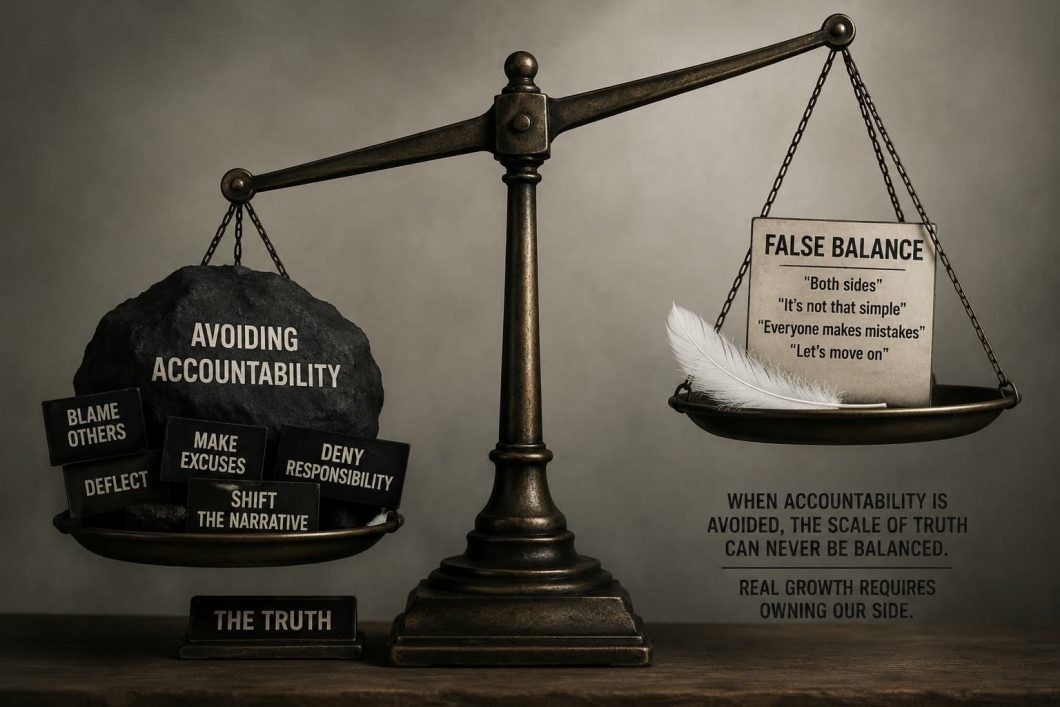
![Alt text: An unbalanced scale illustrating how avoiding accountability hides behind false balance]](https://sevenrootedlife.com/wp-content/uploads/2026/06/avoiding-accoutability-1024x683.jpg)
The Male Experience That Often Goes Unexamined
Consider a pattern many men describe.
You communicate calmly. Nothing changes.
You explain again. Nothing changes.
You try a different approach. Nothing changes.
Eventually the calm runs out. Frustration hardens into anger.
From the outside, people see an angry man. What they do not see are the months, sometimes the years, of patient attempts that came before the anger. They walked in at the last scene and judged the whole story by it.
This does not excuse aggression. Anger that wounds is still anger that wounds, and you are responsible for what you do with it. But if you never ask what produced the anger, you spend your whole life treating symptoms and never touching the cause.
Many men are not asking for permission to be angry. They are asking a more honest question. Why did calm communication accomplish nothing? Why did the reasonable approach fail so completely that only the unreasonable one got noticed?
That question deserves a real answer. Not a deflection. Not a counterweight. An answer.
Accountability Is Not an Attack on Anyone
Naming a harmful pattern is not the same as condemning a gender.
If some women repeatedly invalidate, dismiss, or stonewall reasonable communication from their partners, that pattern deserves examination. Saying so is not misogyny. It is observation.
If some men repeatedly control, neglect, or belittle their partners, that pattern deserves examination too. Saying so is not man-hating. It is observation.
Accountability cannot depend on whose behavior is being discussed. The moment it does, it stops being accountability and becomes loyalty. You are no longer asking what is true. You are asking which side you are on.
![Alt text: Two partners practicing accountability in relationships through honest conversation]](https://sevenrootedlife.com/wp-content/uploads/2026/06/partners-in-acciuntability-1024x683.jpg)
The truth does not care which group it indicts. Research on conflict in long-term partnerships consistently shows that the issue is rarely the presence of disagreement and far more often the pattern of how each person responds to it. You can read the decades of work on this from the Gottman Institute. The behavior is the thing. Not the gender attached to it.
Truth Before Balance
Train yourself to ask questions in the right order.
The first question is never, “Who else does this?”
The first question is, “Is this happening?”
If the answer is yes, then understand it before you compare it to anything else. Sit in it. Let it be true for a moment without immediately diluting it. You can add context later. Context after examination is wisdom. Context before examination is avoidance.
This is hard because your instinct is self-protection. The flesh defends. The flesh deflects. The flesh hears a hard word and reaches for the nearest exit. Growth asks you to stay in the room. This is the same work you have to do when you learn to separate shame from guilt, because shame makes you defend and guilt invites you to change.
Healthy conversations do not require you to soften every difficult truth. They require you to examine difficult truths honestly. Only then can accountability do what it was meant to do, which is not to shame you but to change you.
Relationships do not improve when you defend yourself from every uncomfortable observation. They improve when you find the courage to ask the question most people spend their lives avoiding. And you can ask it without fear, because your worth was never on trial in the first place. Your identity in Christ is settled, which is exactly what frees you to look honestly at yourself.
What if this is true? And what needs to change in me if it is?
That is not a comfortable question. It was never meant to be comfortable. It was meant to be honest.
And honesty, not balance, is where every real change begins.
Tired of the same conflict playing out on repeat? Stuck on Repeat is a free 10-minute self-audit that helps you name the pattern running your relationships and the belief underneath it. Download Stuck on Repeat here.
The patterns you keep repeating are not random. You Are the Pattern shows you how to find the root of what keeps running your life and finally break the cycle. Get your copy here.